 Date: July 29-31, 2025
Rapidly changing trends in the discovery, development and production of new products for Pharmaceuticals, Specialty chemicals, and performance materials requires the effective use of new processing technology to speed development while ensuring the use of high quality, low cost and reliably production practices. This is even more important with the growing use of biobased materials and post-consumer products as feedstocks to improve sustainability while insuring cost competitive production processes. The 2025 CPAC Summer Institute will be built on two themes.
1) Next generation processing approaches to enable maximum efficiency in the production of sustainable materials (pharmaceuticals, chemicals, and biomaterials)
2) Expanding process understanding based on the use of sensors and data handling – Enabling more efficient process optimization and control of complex bio-based processes and petrochemical operations as well as expanding the use of sensors for personalized medicine.
The first theme of sustainable process development and production will include an emphasis on exploring new reaction routes that benefit from the growing use of continuous flow technology and effective monitoring concepts. The evolution of flow microscale reaction technology has led to a wide range of process intensification developments. These include, often using novel operating windows for one-pot and cascade reactions, in the various steps that result in the ability to rapidly evaluate and optimize new reaction routes as well as offering more cost-effective processing. The key next step is the integration of these unit operations into end-to-end optimized continuous processes.
Next generation continuous manufacturing concepts will enable efficient end-to-end bio-processing for the implementation of a sustainable circular economy; based on the data from process analytical technology, PAT, required for rapid characterization of organism growth as well as post reaction processing including product separation and purification.
The second theme will be based on powerful new applications of continuous sensing and control. Just as continuous monitoring can have a significant impact on stable, high efficiency production of chemicals it has also been shown to have a significant impact in the Personalized Medicine area. This second theme will explore the potential of using the pattern of data from groups of simple sensors for faster and better understanding and control in a range of simple sensors for applications in process development including organism growth to enable better product synthesis, and then more efficient post reaction processing.
Of importance to both themes are:
• Recent advances in PAT for the real time characterization of raw materials, process streams, and complex biomass streams – to improve process understanding. This data can be used for rapid process development and for feed forward and feedback control to enable high-quality, cost-effective products.
• Utilization of new approaches in data handling including the use of big data and its characterization by AI methods — for end-to-end understanding and value extraction from chemical and biomass processing.
• Recognition of the importance of solution providers – those companies and academic research groups that have developed measurement approaches, data handling approaches, and engineering concepts for process control
The three-day schedule ends on Thursday afternoon with a BBQ dinner off-site event. The final afternoon will summarize the technical areas and meld the conclusions into a broader look at the future impact of Process Analytical Technology (PAT) for achieving Process Optimization.
CPAC has an established track record in fostering academic/industrial/national laboratory interactions, which aims at bridging the gap between basic research and full-scale process/product development. CPAC’s Summer Institute will provide continuing education opportunities in the areas of advances in measurement science linked to process control.
The CPAC Summer Institutes are held in an informal format, with technical presentations, and time allotted for open discussion and brainstorming on topics that arise from this interaction. The informal environment has created a successful multi-disciplinary format for bringing together chemists, biologists, measurement scientists, and process engineers from industry, government, and academic institutions.
REGISTRATION Fees for the 2024 Summer Institute are $500.00 US Dollars. The fees cover all meeting materials, Tuesday dinner, lunches, and a BBQ dinner on Thursday. Please complete the registration form on the following site or contact:
http://mkcontrol.com/summer-institute-2025.html
Mel Koch, kochm@mkopt.net (cell) +1 206 992 1001 or,
Nan Holmes, nsh@uw.edu, (cell) +1 206 484 4399

 Join Infometrix at ATC 2026 Conference in booth #511 for presentation on Ai-Metrix and the automation of chemometric calibrations.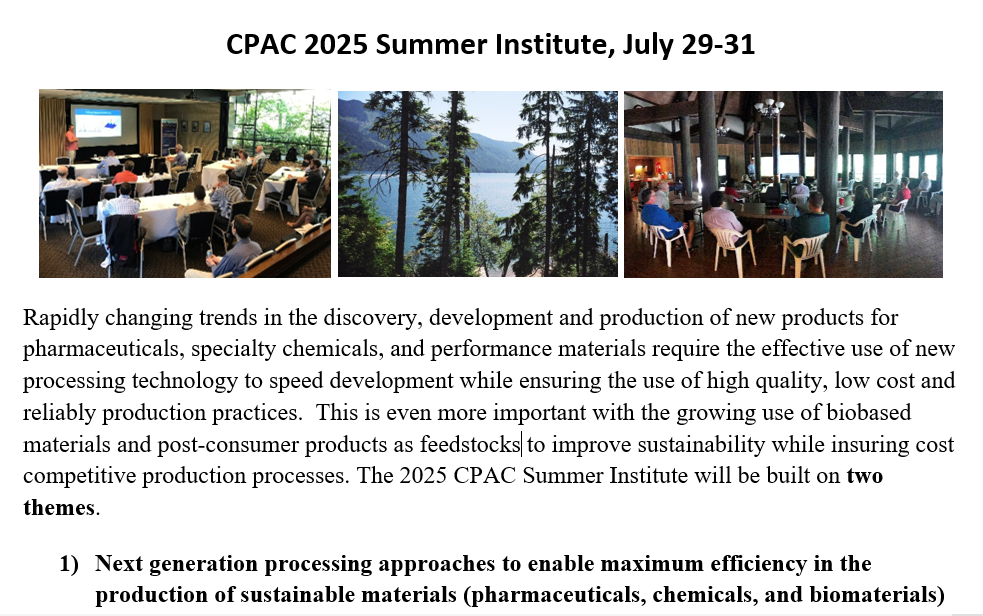


 infometrix.com