Objective Tracking of Calibration Model Quality

In the petroleum industry, this approach is applied at scale. Facilities often monitor dozens or even hundreds of predictive models simultaneously, such as summer, winter, and all-season fuel grades. In this example, 27 models (a 9×3 grid) are tracked, though some refineries monitor more than 300. The system works with any optical instrument and with any chemometrics assessment software.

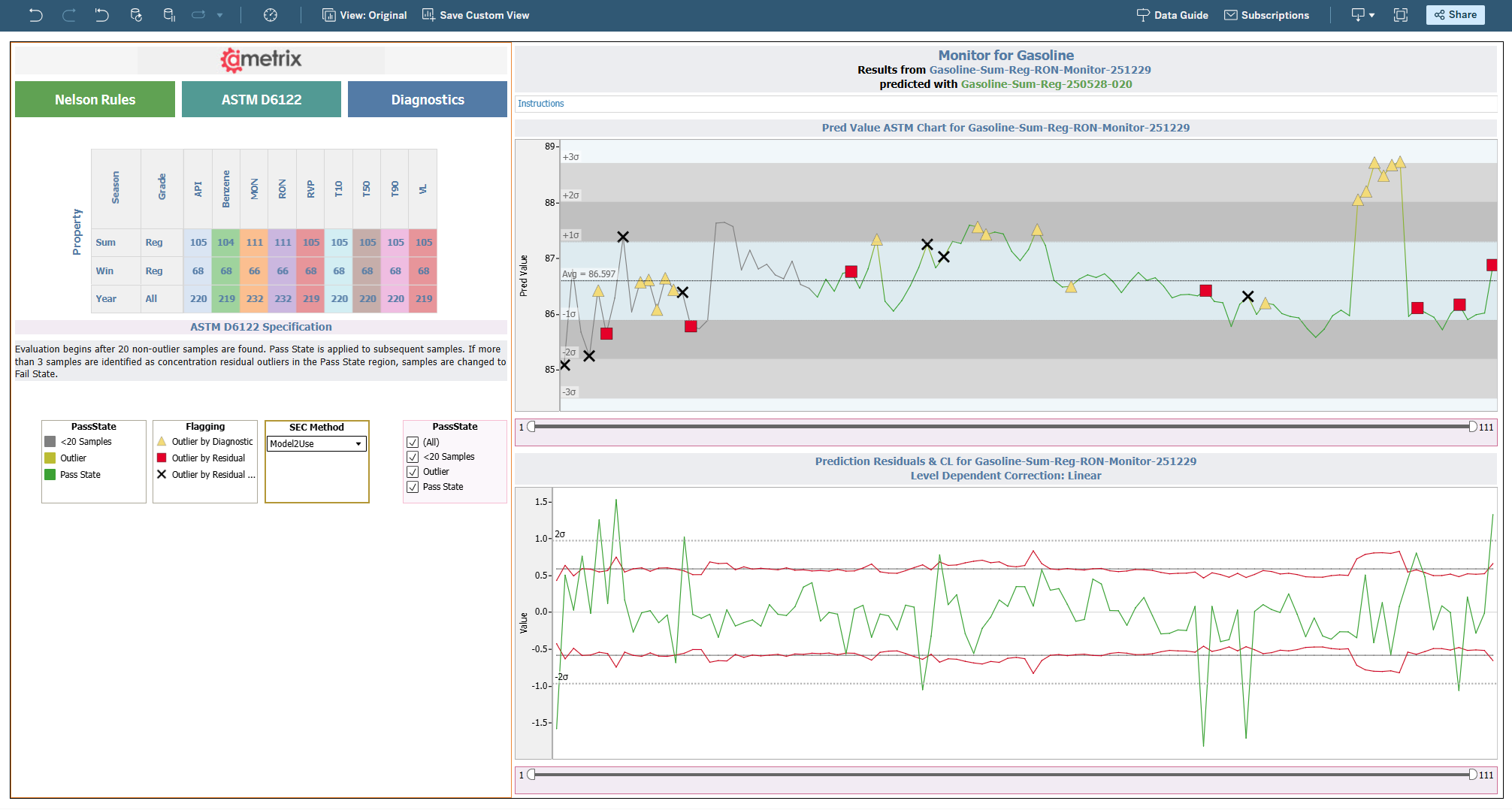
ASTM D6122 provides sample-specific guidelines for evaluating these models. Rather than relying on simple fixed limits, it defines dynamic, sample-specific thresholds. When samples fall outside these limits, Ai-Metrix can kick in to supply an updated model in minutes.

Different visual indicators convey different issues:

  • Yellow triangles represent samples that are statistically in control but unusual for the model. These are often good candidates for inclusion to improve model robustness.
  • Red squares indicate that model diagnostics are acceptable, but the predicted value does not match laboratory results—typically signaling a laboratory error.
  • X markers show both diagnostic failures and unusual samples, indicating a true system failure that requires intervention.

Although the ASTM calculations are complex, they are well-suited for automated computation. Once implemented, users can quickly drill into individual samples to examine diagnostics, model predictions, and laboratory values. This allows identification of discrepancies where the system is stable, but results are out of specification, often revealing process or lab issues rather than model faults.

By compressing large volumes of historical data into actionable metrics and applying these models in real time, organizations can distinguish false positives, detect procedural problems, and better understand the sources of disagreement between manufacturing and laboratory measurements.

ASTM’s work is notable because it formally codifies how to evaluate model performance—something that had not been standardized before. While adoption has been strongest in refining, these methods are largely unknown in pharmaceuticals, chemicals, and food manufacturing.

With real-time feedback and rapid model updates, these systems enable smarter, more adaptive manufacturing. This is where machine learning and AI naturally fit: not as replacements, but as practical overlays that enhance existing workflows and produce outputs that can support regulatory discussions.

Learn more about Ai-Metrix automation. Contact us at info@infometrix.com for a demo.

Quality Assurance with Ai-Metrix Automated Model Validation

Ai-Metrix Automated Model ValidationAi-Metrix®now offers a fully automated model validation framework, combining real-time tracking with powerful diagnostics based on ASTM D6122 and comprehensive Nelson Rule monitoring. Designed to support high-stakes environments like gasoline blending, this feature ensures your predictive models remain accurate, reliable, and audit-ready as new data flows in.

🎯Smarter Monitoring Starts Here
As your team uploads fresh data to the Ai-Metrix server, our system continuously evaluates model performance using robust statistical tools. A streamlined dashboard gives you instant visibility:

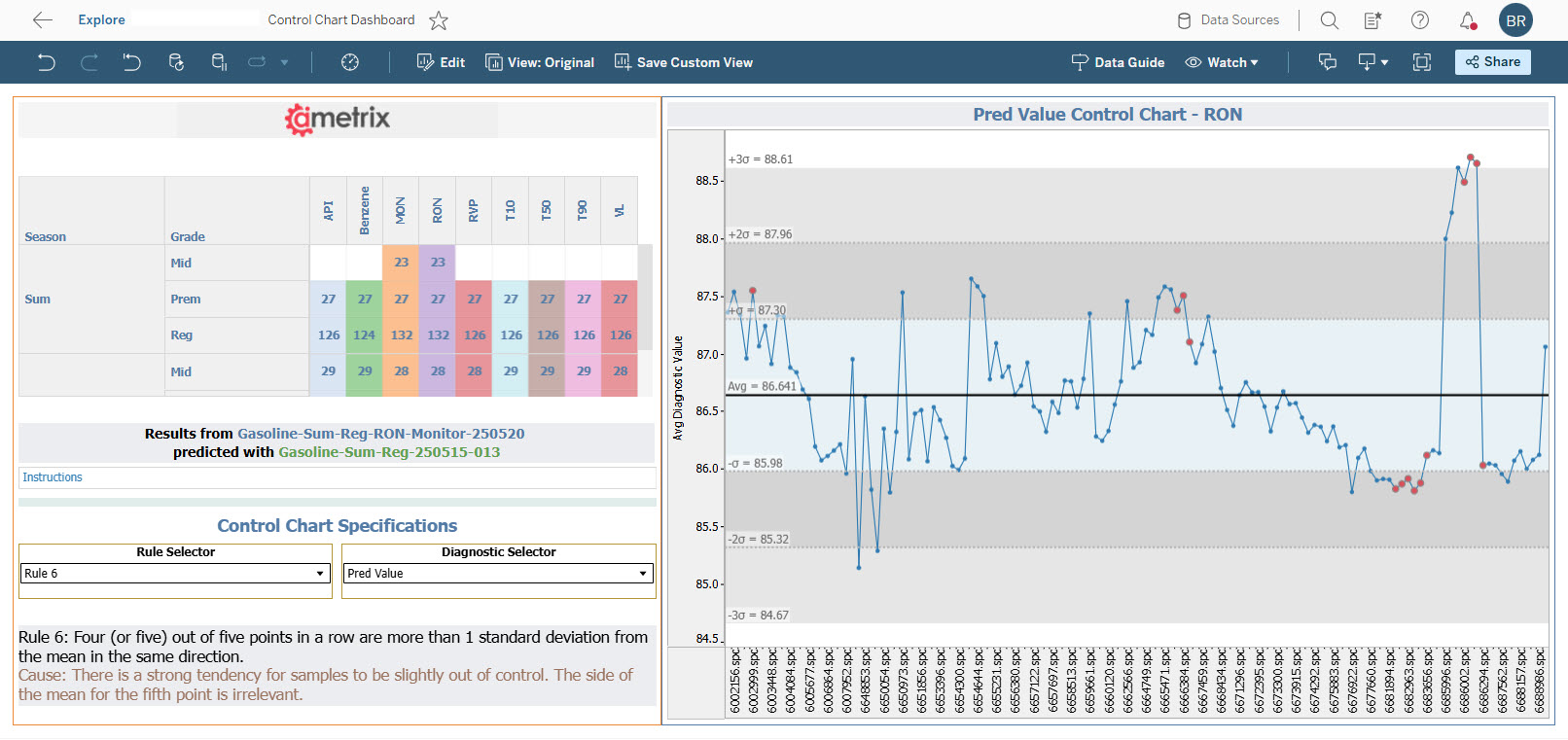
✅ Visual Control Charts – Instantly identify anomalies with trend plots showing ±1, 2, and 3 standard deviations.
✅ Advanced Rule Integration – Choose from Nelson Rules or ASTM D6122 checks to detect early signs of model drift or calibration issues.
✅ Dynamic Model Grid – See all active models at a glance, organized by product grade and property. Click to dive deeper into sample counts and validation metrics.
✅ Flexible Metric Selection – Monitor predicted values, residuals, F-ratios, or Mahalanobis distance to match your validation strategy.
✅ Rule Violations Trigger – Violations can trigger an email to a distribution list for action.

🎯Why It Matters
→ Regulatory Alignment – ASTM D6122 compliance, built-in.
→ Hands-Free Oversight – Continuous, automated validation as data is collected.
→ Proactive Alerts – Catch issues before they affect process quality.
→ Complete Transparency – From calibration sample size to rule violations, everything is traceable and actionable.
→ Real time updates – With the Ai-Metrix calibration power, model updates are available in real time to move the system back into compliance.

🎯Confidence in your models isn’t optional—it’s critical.
Ai-Metrix delivers a smarter, automated approach to model validation that helps your team maintain compliance, ensure process integrity, and make better decisions, faster. Explore the new validation dashboard today and take control of your model quality.

Book a quick demo and see how Ai-Metrix can elevate your operations. info@infometrix.com

“Quality is never an accident. It is always the result of intelligent effort.”
– John Ruskin, English writer (1819-1900)

Bruce R. Kowalski: The Maverick Mind Behind Chemometrics

Bruce R. Kowalski: The Maverick Mind Behind Chemometrics

In this Icons of Spectroscopy article, we take a look at the life and impact of Bruce Kowalski (1942-2012), a pioneering analytical chemist, who played a big role in developing chemometrics—the use of math to make sense of complex chemical data—and his work in data analysis, teaching, and software that has had a lasting influence on both academic and industrial chemistry.

Bruce R. Kowalski, also the co-founder of Infometrix, was a pioneer of chemometrics, known for advancing multivariate statistics and data analysis in chemistry. This article honors his legacy, from shaping chemometric theory and education to co-founding the Journal of Chemometrics. His global impact endures through mentorship, software tools, and leadership in analytical chemistry.

https://www.spectroscopyonline.com/view/bruce-r-kowalski-the-maverick-mind-behind-chemometrics

Chimiométrie XXIV Conference

Chimiometrie XXIV ConferenceVenue: February 26-28, 2024 Géraudière site in Nantes, France Sponsored by: Infometrix, Inc. is one of the proud sponsors of Chimiométrie XXIV Welcome: This meeting brings together academics and industrialists from all fields to promote chemometrics, from data acquisition to analysis and modeling, where sharing of information will be presented through training courses, guest speakers, and a gala dinner. To participate in the meeting or for more information, please visit the website. For any questions, contact chemom2024@sciencesconf.org or info@infometrix.com.

EAS 2021 – Multivariate Lessons for the Analytical Chemist, Scott Ramos

Scott Ramos, recipient of the 2021 EAS Award for Outstanding Achievements in Chemometrics, will give his talk on “Multivariate Lessons for the Analytical Chemist”. Join us November 16th at 11am.

Multivariate Lessons for the Analytical Chemist

The field of chemometrics is a relatively new discipline, with its genesis about 40 years ago. Despite this relatively short history, it is now thriving as a vibrant area of research and practice, finding place in a wide variety of chemical applications. Some of the tools of the trade have found acceptance well outside of chemistry. For example, PLS (Partial Least Squares Regression) has become popular in statistics which was lacking methods for data with highly correlated variables.

Two main thrusts have propelled the evolution of chemometrics: innovation and evangelism. The toolkit available to practitioners is continually being augmented by improvements to current methods as well as creation of new algorithms. But, for the field to succeed, it must reach the hands of those who can benefit: the many analysts who utilize these tools in their daily work.

To meet the needs of already-overworked analysts, working solo or in teams, we can identify at least 3 ways in which multivariate tools can become part of the company work practice: hire a dedicated chemometrician, train one or more of staff members in the use of chemometrics, or contract an outside entity to provide chemometrics services.

Whichever the pathway a company chooses, understanding how best to optimize chemometrics models is paramount to success. This talk will review some of these concepts, covering issues that impact model quality, and will reflect on the viability of automating these decisions.