
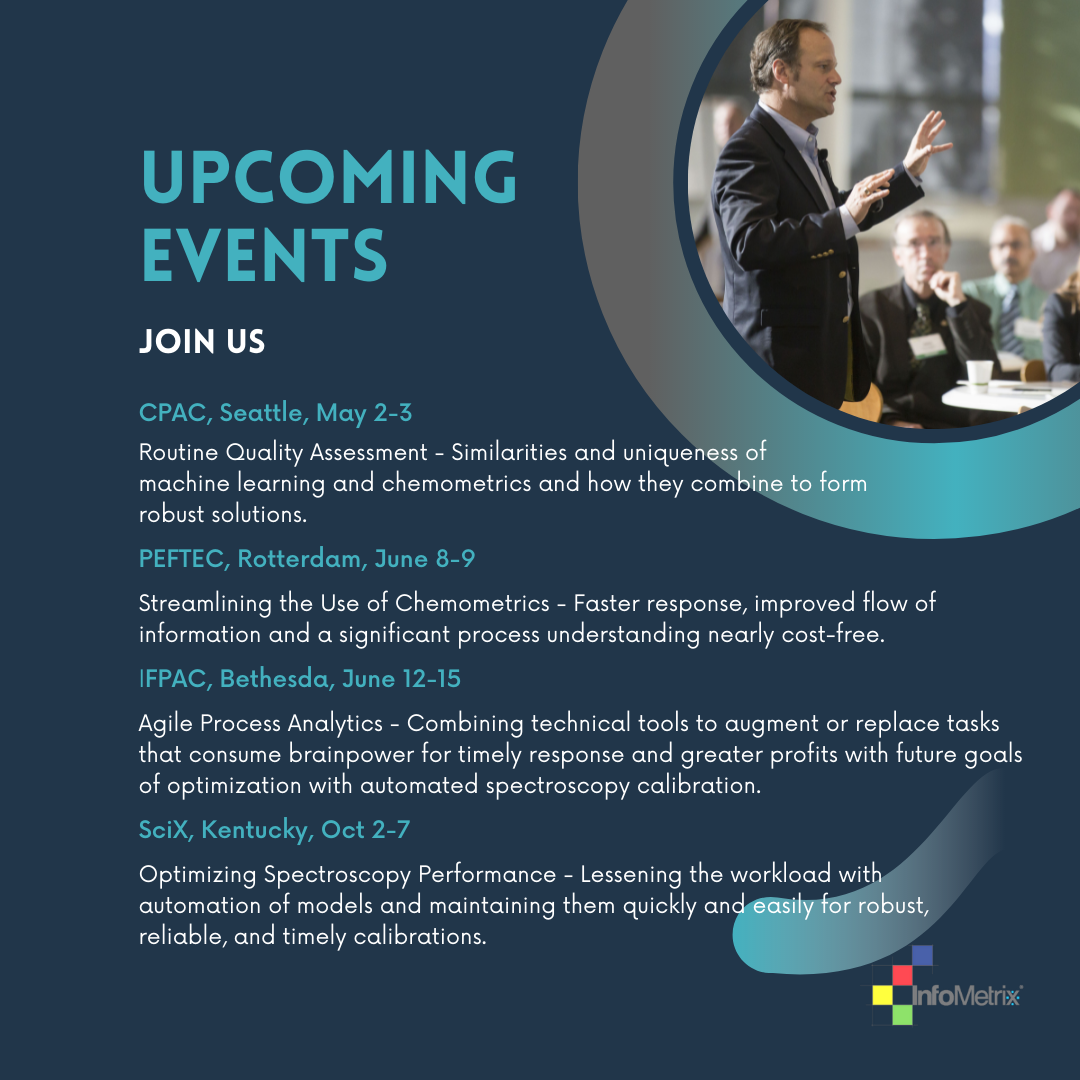
Join Brian Rohrback of Infometrix, Inc. for his talk on Agile Process Analytics, June 14, 1:05pm EST.
Agile Process Analytics
Application knowledge and chemometrics play a vital role in the processing of all types of multivariate data into application-specific information and has been doing so for at least 50 years. There has been a not-so-subtle shift in thinking as we integrate basic concepts and the occasional hallucination in the data mining, artificial intelligence, machine learning worlds. The target is to identify combinations of our technical tools to augment or replace tasks that consume brainpower where timely response is valued, and profits are at risk. The biggest focus of chemometrics has been in the calibration of optical spectrometers. It is worth considering the subtasks:
- Optimizing the instrument settings for a given application;
- Optimizing the method parameters – preprocessing, transformations, wavelength ranges;
- Handling of calibration transfer; and
- Optimizing models for inliers and rank in pursuit of routine processing and adjusting to changes in ingredients and unit operation.
The first two tasks are a set-once method development and the third may be generic across all applications. This paper tackles subtask 4 with a project that combined traditional approaches in statistics, database organization, pattern recognition, and chemometrics with some newer concepts tied to better understanding of data mining, neurocomputing, and machine learning. The future goal is to automate spectroscopy calibrations such that it is possible to have instrument systems tune themselves.

 Venue:
April 15-19, 2024
Galveston Island Convention Center
Presented by:
Brian Rohrback, Ph.D., MBA, President, Infometrix, Inc.
Abstract:
Obviously, to control quality in manufacturing, one needs to have some way of measuring the quality of the process and the product. Also critical is to optimize the action plan on how to process signal to gain the information content, to deliver the answers, and to facilitate maintenance. The field of optical spectroscopy has been critical to QC operations as a set of non-destructive technologies providing insight into the chemistry of the product. Spectrometers can deliver chemical information quickly and the on-going cost of ownership is relatively low. The quality of the information content will be a function of the analytical technology behind the instrument (NIR, Raman, UV-Vis) and analyzer calibration; the calibration task is the only one that falls to the end user on a routine basis. Maintaining best practices for spectroscopic calibration and identifying areas where the process can be streamlined is critical to preserve the value in the company’s investment in optical spectroscopy.
Register at https://www.analyzertechconference.org/.
Venue:
April 15-19, 2024
Galveston Island Convention Center
Presented by:
Brian Rohrback, Ph.D., MBA, President, Infometrix, Inc.
Abstract:
Obviously, to control quality in manufacturing, one needs to have some way of measuring the quality of the process and the product. Also critical is to optimize the action plan on how to process signal to gain the information content, to deliver the answers, and to facilitate maintenance. The field of optical spectroscopy has been critical to QC operations as a set of non-destructive technologies providing insight into the chemistry of the product. Spectrometers can deliver chemical information quickly and the on-going cost of ownership is relatively low. The quality of the information content will be a function of the analytical technology behind the instrument (NIR, Raman, UV-Vis) and analyzer calibration; the calibration task is the only one that falls to the end user on a routine basis. Maintaining best practices for spectroscopic calibration and identifying areas where the process can be streamlined is critical to preserve the value in the company’s investment in optical spectroscopy.
Register at https://www.analyzertechconference.org/.

 infometrix.com