Come visit booth #119 at the Gulf Coast Conference in October and join Brian Rohrback to learn more about eliminating retention time shifts in chromatography and automating calibration for optical spectrometers to enable better models and optimize use of personnel. Gulf Coast Conference 2024
Calibration
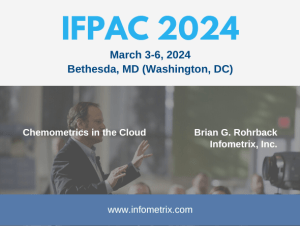
IFPAC 2024 – Chemometrics in the Cloud
Venue:
March 3-6, 2024
Bethesda North Marriott Hotel and Conference Center
Presented by:
Brian Rohrback, Ph.D., MBA, President, Infometrix, Inc.
Abstract:
In the spirit of automation, there are cloud-based tools from both the chemometrics and the general statistics realms that can be applied to simplify the work involved in optimizing a calibration. Robust statistical techniques require some set-up of parameters, but once established for an application, they are often usable in every other instance of that application. The result is a one-pass automated means of selecting optimal samples for a calibration problem and, in turn, simplifies and automates the assignment of model rank. In the end case, this means that a spectrometer can essentially become an appliance; take it out of the box, plug it in, and enjoy. The capability exists to have a spectrometer self-tune and adapt to a specific application, then keep the spectrometer in appropriate calibration completely through closed-loop control. Automation of best practices needs to include how to match laboratory reference data to spectral data, an unbiased approach to selecting validation samples, an optimal mechanism for model construction, establishing standards for quality reports, tracking model performance over time, handling process or ingredient transitions, and much more.
Register at www.IFPACglobal.org/attendee-registration.
PITTCON 2024 – Spectroscopy and the Intersection with Machine Learning
Venue:
February 24-28, 2024
San Diego Convention Center
Presented by:
Brian Rohrback, Ph.D., MBA, President, Infometrix, Inc.
Abstract:
Application knowledge and chemometrics play a vital role in the processing of all types of multivariate data into application-specific information and has been doing so for at least 50 years. There has been a not-so-subtle shift in thinking as we integrate basic concepts and the occasional hallucination in the data mining, artificial intelligence, machine learning worlds. The target is to identify combinations of our technical tools to augment or replace tasks that consume brainpower where timely response is valued, and profits are at risk. The biggest focus of chemometrics has been in the calibration of optical spectrometers. It is worth considering the subtasks:
- Optimizing the instrument settings for a given application;
- Optimizing the method parameters – preprocessing, transformations, wavelength ranges;
- Handling of calibration transfer; and
- Optimizing models for inliers and rank in pursuit of routine processing and adjusting to changes in ingredients and unit operation.
Newsletter #20 – Performance Check – Time for Change?
The Sept 2023 Infometrix eNews was recently published. Included in this newsletter:
-Introduction
-Change of Seasons – Move, Software Update and Ai-Metrix
-Upcoming Events
-Tech Tip: Chromatographic Alignment
-After Further Review…Practical AI for Manufacturing
IFPAC 2023 – The Multiverse of Challenges for Spectral Libraries
Venue:
Time to be announced
Bethesda North Marriott Hotel and Conference Center
Presented by:
Brian Rohrback, Ph.D., MBA, President, Infometrix, Inc.
Abstract:
There are challenges when considering application-specific libraries of optical spectra. For most quality control applications in industry, there is no standard set of spectra available as the process is typically tied to a set of (unique) analytes mixed in various proportions. Add in changes from ingredient suppliers, seasonal variations, and changes in unit operation, there is not a pinpoint target for assessing quality. Luckily, we have more than a half century of processing data like this using chemometrics and the newer moniker machine learning. But handling process libraries is not just a simple application of an appropriate algorithm; there are challenges that need to be considered in all aspects of sample collection, handling instrument drift, and ensuring consistency across all operators. An outline of best practices needs to include how to match laboratory reference data to spectral data, an unbiased mechanism for selecting validation samples, an optimal mechanism for model construction, establishing standards for quality reports, tracking model performance over time, handling process or ingredient transitions, and much more. A systematic approach to building, maintaining, and benefiting from an application-specific spectral library is presented as part of the USP effort to establish appropriate standard practices.
Register at www.IFPACglobal.org/attendee-registration.