Unlock Data. Discover Systems. Save Big

IMAGE '25 MeetingVenue: George R. Brown Convention Center, Houston, TX

Date: August 24, 2025

Short Course:  SC-01: Chemometric Tools to Establish Petroleum Systems, Predict Physical Properties, and De-Convolute Mixed Production

Special Software Discount for SC-01 Attendees

Join Infometrix at IMAGE 2025 and discover how multivariate data analysis is transforming petroleum geoscience.

Dr. Kenneth Peters from LSB NExT Training and Brian Rohrback from Infometrix will be leading the short course Sunday, August 24th at the George R. Brown Convention Center.

This one-day course demonstrates how chemometric techniques, using real-world datasets, can enhance interpretation of geochemical, petrophysical, and production data – all powered by Infometrix Pirouette® software.

Exclusive Offer:
Register for SC-01 and receive a discount on Infometrix software license, optimized for the workflows presented in the course.

Expand your skillset. Enhance your toolkit. 
Learn from experienced instructors and leave with the power of advanced analytics at your fingertips.

Register today and claim your software discount.


Infometrix: Turning complex data into confident decisions.


Bruce R. Kowalski: The Maverick Mind Behind Chemometrics

Bruce R. Kowalski: The Maverick Mind Behind Chemometrics

In this Icons of Spectroscopy article, we take a look at the life and impact of Bruce Kowalski (1942-2012), a pioneering analytical chemist, who played a big role in developing chemometrics—the use of math to make sense of complex chemical data—and his work in data analysis, teaching, and software that has had a lasting influence on both academic and industrial chemistry.

Bruce R. Kowalski, also the co-founder of Infometrix, was a pioneer of chemometrics, known for advancing multivariate statistics and data analysis in chemistry. This article honors his legacy, from shaping chemometric theory and education to co-founding the Journal of Chemometrics. His global impact endures through mentorship, software tools, and leadership in analytical chemistry.

https://www.spectroscopyonline.com/view/bruce-r-kowalski-the-maverick-mind-behind-chemometrics

IMAGE ’25 – International Meeting for Applied Geoscience & Energy

IMAGE '25 MeetingVenue: George R. Brown Convention Center, Houston, TX

Date: August 24-28, 2025

Short Course:  SC-01: Chemometric Tools to Establish Petroleum Systems, Predict Physical Properties, and De-Convolute Mixed Production

Course Leaders: Dr. Kenneth Peters from LSB NExT Training and Brian Rohrback from Infometrix will be leading the short course on August 24th.

This one-day course is for all geoscientists who want to extract hidden information from substantial amounts of chemical and physical data using multivariate statistical (chemometric) tools. The course emphasizes applications rather than the mathematics of various chemometric methods and will include a demo version of Pirouette 5.0 chemometric software. Case studies focus on the following topics of immediate interest to geoscientists:

• Hierarchical cluster analysis (HCA) and principal component analysis (PCA) of biomarker and stable isotope data for oil-oil and oil-source rock correlation to establish petroleum systems.
• Quantitative regression analysis of chromatographic peaks by alternate least squares (ALS) to de-convolute mixed oils derived from two or more sources. In exploration, ALS identifies mixed oils (e.g., pre-salt and post-salt oils in the Middle East and Southern Atlantic). In production, ALS allows allocation of mixtures originating from multiple reservoir zones.
• Prediction of physical properties by partial least squares (PLS) of data obtained by micro-analytical techniques. PLS allows investigators to predict API gravity, sulfur, and viscosity for reservoir zones where only small samples of cuttings from storage are available for analysis.

For questions or more information, contact info@infometrix.com.

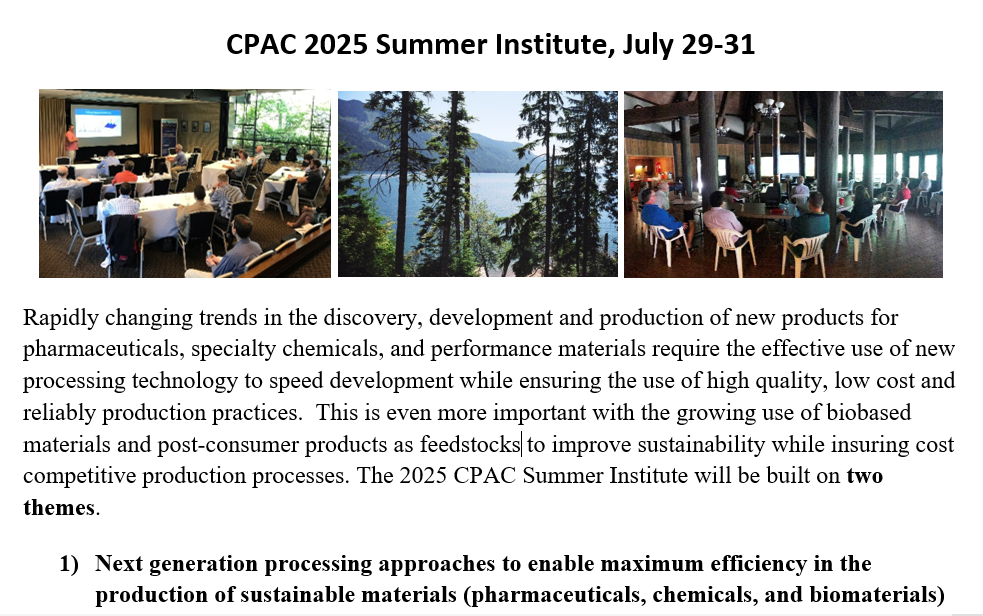
CPAC 2025 Summer Institute, July 29-31

CPAC 2025 Summer InstituteDate: July 29-31, 2025

Rapidly changing trends in the discovery, development and production of new products for Pharmaceuticals, Specialty chemicals, and performance materials requires the effective use of new processing technology to speed development while ensuring the use of high quality, low cost and reliably production practices.  This is even more important with the growing use of biobased materials and post-consumer products as feedstocks to improve sustainability while insuring cost competitive production processes. The 2025 CPAC Summer Institute will be built on two themes.

1)    Next generation processing approaches to enable maximum efficiency in the production of sustainable materials (pharmaceuticals, chemicals, and biomaterials)

2)    Expanding process understanding based on the use of sensors and data handling – Enabling more efficient process optimization and control of complex bio-based processes and petrochemical operations as well as expanding the use of sensors for personalized medicine.

The first theme of sustainable process development and production will include an emphasis on exploring new reaction routes that benefit from the growing use of continuous flow technology and effective monitoring concepts. The evolution of flow microscale reaction technology has led to a wide range of process intensification developments. These include, often using novel operating windows for one-pot and cascade reactions, in the various steps that result in the ability to rapidly evaluate and optimize new reaction routes as well as offering more cost-effective processing. The key next step is the integration of these unit operations into end-to-end optimized continuous processes.

Next generation continuous manufacturing concepts will enable efficient end-to-end bio-processing for the implementation of a sustainable circular economy; based on the data from process analytical technology, PAT, required for rapid characterization of organism growth as well as post reaction processing including product separation and purification.

The second theme will be based on powerful new applications of continuous sensing and control.  Just as continuous monitoring can have a significant impact on stable, high efficiency production of chemicals it has also been shown to have a significant impact in the Personalized Medicine area. This second theme will explore the potential of using the pattern of data from groups of simple sensors for faster and better understanding and control in a range of simple sensors for applications in process development including organism growth to enable better product synthesis, and then more efficient post reaction processing.

Of importance to both themes are:

• Recent advances in PAT for the real time characterization of raw materials, process streams, and complex biomass streams – to improve process understanding. This data can be used for rapid process development and for feed forward and feedback control to enable high-quality, cost-effective products.

• Utilization of new approaches in data handling including the use of big data and its characterization by AI methods — for end-to-end understanding and value extraction from chemical and biomass processing.

• Recognition of the importance of solution providers – those companies and academic research groups that have developed measurement approaches, data handling approaches, and engineering concepts for process control

The three-day schedule ends on Thursday afternoon with a BBQ dinner off-site event. The final afternoon will summarize the technical areas and meld the conclusions into a broader look at the future impact of Process Analytical Technology (PAT) for achieving Process Optimization.

CPAC has an established track record in fostering academic/industrial/national laboratory interactions, which aims at bridging the gap between basic research and full-scale process/product development. CPAC’s Summer Institute will provide continuing education opportunities in the areas of advances in measurement science linked to process control.

The CPAC Summer Institutes are held in an informal format, with technical presentations, and time allotted for open discussion and brainstorming on topics that arise from this interaction. The informal environment has created a successful multi-disciplinary format for bringing together chemists, biologists, measurement scientists, and process engineers from industry, government, and academic institutions.

REGISTRATION Fees for the 2024 Summer Institute are $500.00 US Dollars. The fees cover all meeting materials, Tuesday dinner, lunches, and a BBQ dinner on Thursday. Please complete the registration form on the following site or contact:

http://mkcontrol.com/summer-institute-2025.html

Mel Koch, kochm@mkopt.net (cell) +1 206 992 1001 or,

Nan Holmes, nsh@uw.edu, (cell) +1 206 484 4399

IFPAC 2024 – Real Time Data Analysis for Process Development

IFPAC 2024Venue: March 3-6, 2024 Bethesda North Marriott Hotel and Conference Center Presented by: Brian Rohrback, Ph.D., MBA, President, Infometrix, Inc.   Abstract: Addressing challenges is why we are here. As scientists in our organizations, we are awash in data, but the mustering of these data into their actionable information content is a significant challenge. Clearly, we have tools from the univariate and multivariate statistical trove that help. Relatively recently, artificial intelligence or novel machine learning concepts are being applied with some success. Choosing the tools we apply and using these tools appropriately presents us with another challenge. Noting that the desired property metric will likely be only lightly correlated to the bits of data being assembled is challenging; blending the information extraction process for disparate sources of data adds to the challenge. From manufacturing quality monitoring to personalized medicine, diagnosing the health status needs to be done in real time for us to maintain reasonable control. The first step is to ensure that the input data is as noise-free as possible. Next is to turn data into an information feed that can be combined with other sources. Challenges reappear as we look to mine these data-information streams for a best-fit solution. Register at www.IFPACglobal.org/attendee-registration.