Objective Tracking of Calibration Model Quality

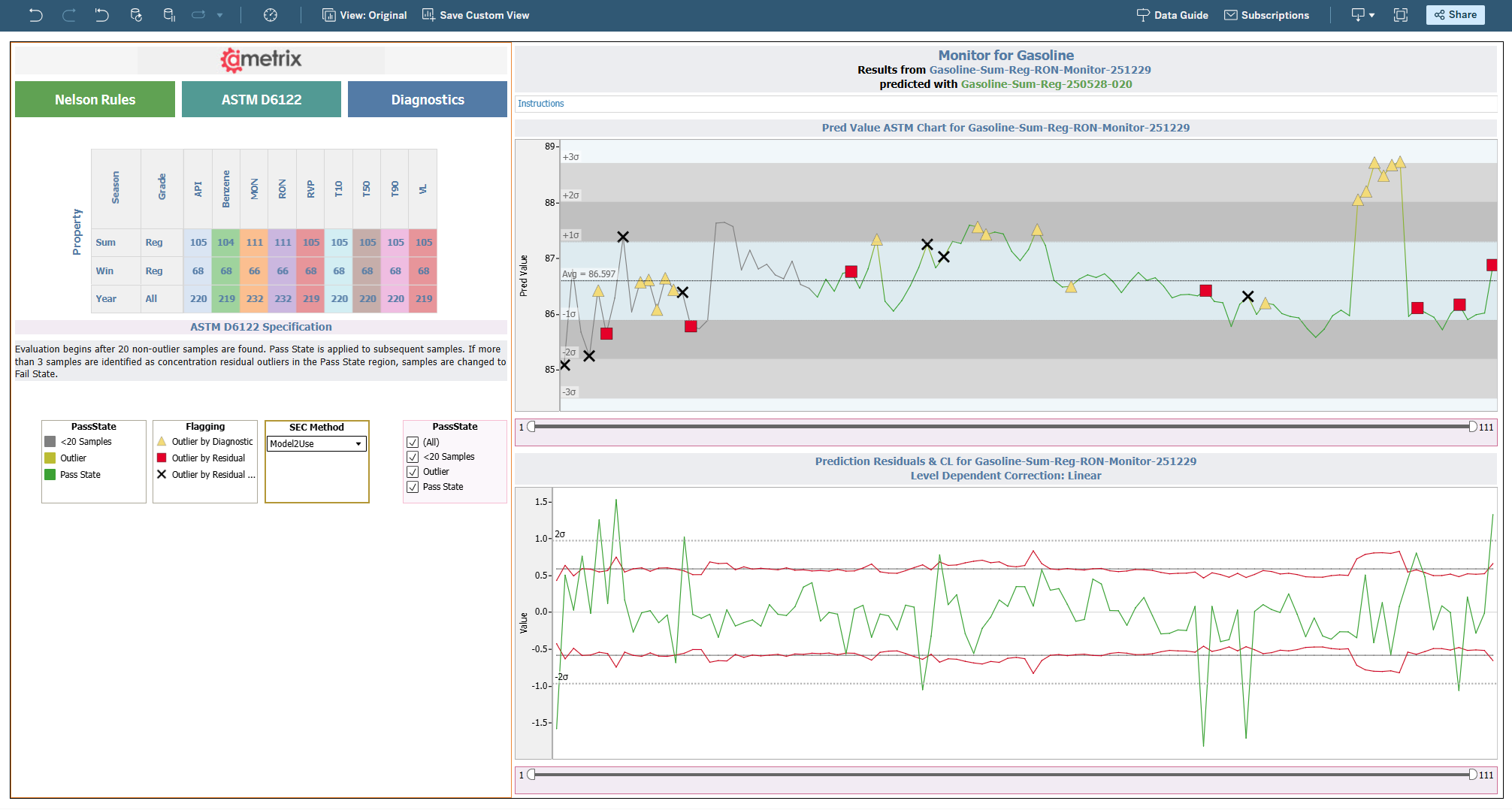
In the petroleum industry, this approach is applied at scale. Facilities often monitor dozens or even hundreds of predictive models simultaneously, such as summer, winter, and all-season fuel grades. In this example, 27 models (a 9×3 grid) are tracked, though some refineries monitor more than 300. The system works with any optical instrument and with any chemometrics assessment software.

ASTM D6122 provides sample-specific guidelines for evaluating these models. Rather than relying on simple fixed limits, it defines dynamic, sample-specific thresholds. When samples fall outside these limits, Ai-Metrix can kick in to supply an updated model in minutes.

Different visual indicators convey different issues:

  • Yellow triangles represent samples that are statistically in control but unusual for the model. These are often good candidates for inclusion to improve model robustness.
  • Red squares indicate that model diagnostics are acceptable, but the predicted value does not match laboratory results—typically signaling a laboratory error.
  • X markers show both diagnostic failures and unusual samples, indicating a true system failure that requires intervention.

Although the ASTM calculations are complex, they are well-suited for automated computation. Once implemented, users can quickly drill into individual samples to examine diagnostics, model predictions, and laboratory values. This allows identification of discrepancies where the system is stable, but results are out of specification, often revealing process or lab issues rather than model faults.

By compressing large volumes of historical data into actionable metrics and applying these models in real time, organizations can distinguish false positives, detect procedural problems, and better understand the sources of disagreement between manufacturing and laboratory measurements.

ASTM’s work is notable because it formally codifies how to evaluate model performance—something that had not been standardized before. While adoption has been strongest in refining, these methods are largely unknown in pharmaceuticals, chemicals, and food manufacturing.

With real-time feedback and rapid model updates, these systems enable smarter, more adaptive manufacturing. This is where machine learning and AI naturally fit: not as replacements, but as practical overlays that enhance existing workflows and produce outputs that can support regulatory discussions.

Learn more about Ai-Metrix automation. Contact us at info@infometrix.com for a demo.

APACT 2025 Conference. Don’t Miss It.

APACT 2025 ConferenceVenue: Hilton Glasgow, 1 William Street, Glasgow, G3 8HT

Date: Sep 23 – 25, 2025

https://apact.co.uk/


The APACT meeting is one of the most dynamic forums for integrating a detailed knowledge of analytical chemistry and how to best manage change from data-centric to information-centric processes.

The combination of process-focused academics and a diverse set of industry people makes the APACT meeting both informative and enjoyable.  The team at CPACT is second to none at organizing and conducting a tight meeting.

Chemometrics & Advanced Data Analysis
Tuesday Sept 23, 2025
11:00 – 11:25
Chemometrics versus machine learning
Brian Rohrback
Infometrix, Inc.

Unlock Data. Discover Systems. Save Big

IMAGE '25 MeetingVenue: George R. Brown Convention Center, Houston, TX

Date: August 24, 2025

Short Course:  SC-01: Chemometric Tools to Establish Petroleum Systems, Predict Physical Properties, and De-Convolute Mixed Production

Special Software Discount for SC-01 Attendees

Join Infometrix at IMAGE 2025 and discover how multivariate data analysis is transforming petroleum geoscience.

Dr. Kenneth Peters from LSB NExT Training and Brian Rohrback from Infometrix will be leading the short course Sunday, August 24th at the George R. Brown Convention Center.

This one-day course demonstrates how chemometric techniques, using real-world datasets, can enhance interpretation of geochemical, petrophysical, and production data – all powered by Infometrix Pirouette® software.

Exclusive Offer:
Register for SC-01 and receive a discount on Infometrix software license, optimized for the workflows presented in the course.

Expand your skillset. Enhance your toolkit. 
Learn from experienced instructors and leave with the power of advanced analytics at your fingertips.

Register today and claim your software discount.


Infometrix: Turning complex data into confident decisions.


Bruce R. Kowalski: The Maverick Mind Behind Chemometrics

Bruce R. Kowalski: The Maverick Mind Behind Chemometrics

In this Icons of Spectroscopy article, we take a look at the life and impact of Bruce Kowalski (1942-2012), a pioneering analytical chemist, who played a big role in developing chemometrics—the use of math to make sense of complex chemical data—and his work in data analysis, teaching, and software that has had a lasting influence on both academic and industrial chemistry.

Bruce R. Kowalski, also the co-founder of Infometrix, was a pioneer of chemometrics, known for advancing multivariate statistics and data analysis in chemistry. This article honors his legacy, from shaping chemometric theory and education to co-founding the Journal of Chemometrics. His global impact endures through mentorship, software tools, and leadership in analytical chemistry.

https://www.spectroscopyonline.com/view/bruce-r-kowalski-the-maverick-mind-behind-chemometrics

IMAGE ’25 – International Meeting for Applied Geoscience & Energy

IMAGE '25 MeetingVenue: George R. Brown Convention Center, Houston, TX

Date: August 24-28, 2025

Short Course:  SC-01: Chemometric Tools to Establish Petroleum Systems, Predict Physical Properties, and De-Convolute Mixed Production

Course Leaders: Dr. Kenneth Peters from LSB NExT Training and Brian Rohrback from Infometrix will be leading the short course on August 24th.

This one-day course is for all geoscientists who want to extract hidden information from substantial amounts of chemical and physical data using multivariate statistical (chemometric) tools. The course emphasizes applications rather than the mathematics of various chemometric methods and will include a demo version of Pirouette 5.0 chemometric software. Case studies focus on the following topics of immediate interest to geoscientists:

• Hierarchical cluster analysis (HCA) and principal component analysis (PCA) of biomarker and stable isotope data for oil-oil and oil-source rock correlation to establish petroleum systems.
• Quantitative regression analysis of chromatographic peaks by alternate least squares (ALS) to de-convolute mixed oils derived from two or more sources. In exploration, ALS identifies mixed oils (e.g., pre-salt and post-salt oils in the Middle East and Southern Atlantic). In production, ALS allows allocation of mixtures originating from multiple reservoir zones.
• Prediction of physical properties by partial least squares (PLS) of data obtained by micro-analytical techniques. PLS allows investigators to predict API gravity, sulfur, and viscosity for reservoir zones where only small samples of cuttings from storage are available for analysis.

For questions or more information, contact info@infometrix.com.