Pittcon Conference + Exposition 2026

Pittcon 2026Speed Dating Chemometrics and Machine Learning

Tuesday, March 10, 2026 1:30 – 3:00 PM · (America/Chicago), Room 006B

San Antonio, TX | Henry B. González Convention Ctr

Details and registration for the session on Speed Dating Chemometrics and Machine Learning, presented by Brian Rohrback, can be found here or you can contact info@infometrix.com for more information.

Abstract
There is a lot of confusion on what constitutes best practices in the application of multivariate statistics to laboratory, process, and field analytics. The terminology in use does not always clarify and most of the time a technique touted in the literature is not compared to any other technology that could be applied to the same problem. The focus here is to refresh the basics of the field of multivariate analysis and data visualization plus how the history of the field now ties to machine learning. The course illustrates the principles of chemometrics as they apply to routine product quality maintenance, primarily on the most common use of the algorithms in organizing the information flow from sensors, spectrometers, and chromatographs.
An introduction to data visualization and exploratory data analysis techniques such as principal component analysis (PCA) and hierarchical cluster analysis (HCA) will be covered along with the practical basis for their use. A wide variety of examples will be shown ranging from laboratory analysis, in-line and on-line process monitoring, and field applications. The course covers the thought process that helps organize and complete the implementation of an application-specific evaluation system.
These topics are designed to cover the best practices of chemometrics technology and will prepare participants for tackling a vast array of problems. This course is useful for any scientist concerned with optimizing their analytical methods to get the most out of either laboratory or process operations.

IFPAC 2026 Presentations

IFPAC 2026SAVE THE DATE FOR IFPAC-2026! Network and share your knowledge on advancements in manufacturing science. Join Brian Rohrback for the following presentations.

Chemometrics in Chromato-Context (ID# 83)

Chromatography is one of the most useful technologies to employ for routine chemical assessment in industry. In many cases, it is the cheapest and most adaptable technology available to fully document the composition of our samples. Chemometrics has been used to interpret chromatographic traces, although the implementation has been far less than seen in spectroscopic applications.  It gives us the chance to review where chemometrics has been utilized in the chromatographic sciences and where the advantages lie.   Starting with the chromatography basics, this presentation builds up the world of chemometrics step-by-step to show where the technology has been used and can contribute in the form of driving much more reliable results from the data we collect.

Fully Integrated Data Analysis (ID# 84)

We employ many sources of analytical information to perform quality control on the processes we manage.  In many cases, we are not utilizing the information content from the data we currently collect.  In most quality control situations, results from different sources will need to be merged into a single release metric. This can be done hierarchically, where information will need to be factored in order of priority or response time.  Another option is to process simultaneous data in a blended, data fusion model.    Care must be taken to ensure that the complexity of fusing several sources of data does not involve so much complexity that the system is unwieldy or simply cannot be used. Here we will discuss current techniques and show how the value of the information stream can be improved by more timely integrated data analysis.  An example from the pharmaceutical classification of botanicals shows the power of this approach.

Chemometrics – COPA (Chemometrics for Online Process Analysis)

Chairs: Brian Rohrback, Infometrix, Antonio Benedetti, Polymodelshub, and Hossein Hamedi, Arrantabio

Chemometrics is central to all calibration work in spectroscopy and has influence in most of the instrumentation tied to product quality control. We are investigating the challenges and the successes tied to the implementation of chemometric technology as it relates to the process industry, whether for pharmaceuticals, for consumer products, for food, or for chemicals. We seek to optimize quality control.

Globalized Spectroscopy (ID#261)

Implementing spectroscopy applications is often a complex management process, even if the deployment is restricted to a single spectrometer.  When a company wants to roll out spectroscopy in multiple locations additional potential problems arise however, managed properly, the benefits are significant.  IR, NIR, and Raman are the most common optical systems employed to measure chemistry in a quality control application, but they require a calibration to convert spectral signatures to the properties of interest.  Unless an objective mechanism for performing calibration is available across the sites, product quality results will vary.  It is possible to package “best practices” into a system that forces consistency and optimal outcome.  By removing the subjective nature of manual calibrations, the quality of the quality control can be assessed and maintained at a high level.

View the program preview here.

Contact info@infometrix.com for questions or for more information on presentations and event details.

Objective Tracking of Calibration Model Quality

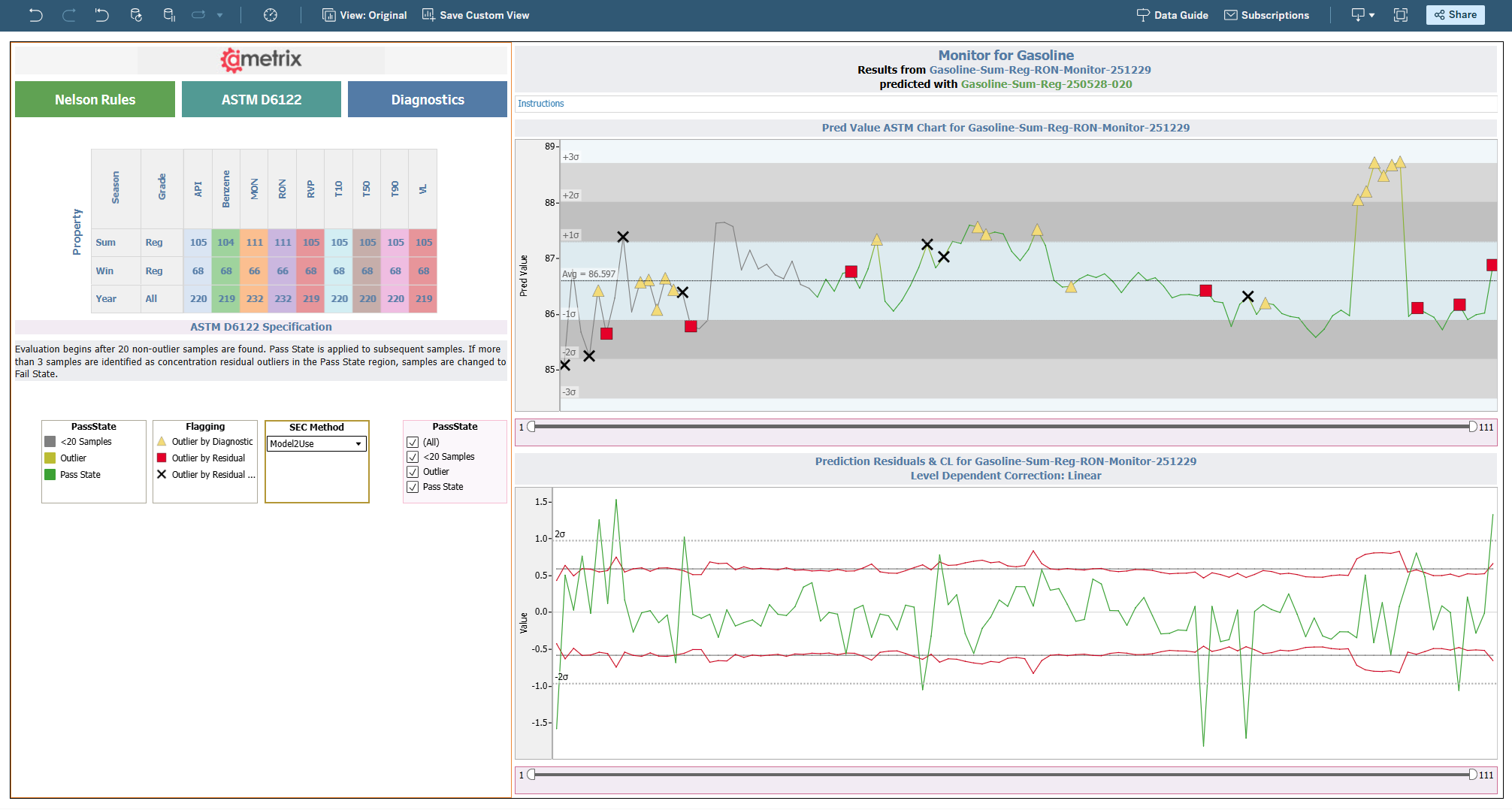
In the petroleum industry, this approach is applied at scale. Facilities often monitor dozens or even hundreds of predictive models simultaneously, such as summer, winter, and all-season fuel grades. In this example, 27 models (a 9×3 grid) are tracked, though some refineries monitor more than 300. The system works with any optical instrument and with any chemometrics assessment software.

ASTM D6122 provides sample-specific guidelines for evaluating these models. Rather than relying on simple fixed limits, it defines dynamic, sample-specific thresholds. When samples fall outside these limits, Ai-Metrix can kick in to supply an updated model in minutes.

Different visual indicators convey different issues:

  • Yellow triangles represent samples that are statistically in control but unusual for the model. These are often good candidates for inclusion to improve model robustness.
  • Red squares indicate that model diagnostics are acceptable, but the predicted value does not match laboratory results—typically signaling a laboratory error.
  • X markers show both diagnostic failures and unusual samples, indicating a true system failure that requires intervention.

Although the ASTM calculations are complex, they are well-suited for automated computation. Once implemented, users can quickly drill into individual samples to examine diagnostics, model predictions, and laboratory values. This allows identification of discrepancies where the system is stable, but results are out of specification, often revealing process or lab issues rather than model faults.

By compressing large volumes of historical data into actionable metrics and applying these models in real time, organizations can distinguish false positives, detect procedural problems, and better understand the sources of disagreement between manufacturing and laboratory measurements.

ASTM’s work is notable because it formally codifies how to evaluate model performance—something that had not been standardized before. While adoption has been strongest in refining, these methods are largely unknown in pharmaceuticals, chemicals, and food manufacturing.

With real-time feedback and rapid model updates, these systems enable smarter, more adaptive manufacturing. This is where machine learning and AI naturally fit: not as replacements, but as practical overlays that enhance existing workflows and produce outputs that can support regulatory discussions.

Learn more about Ai-Metrix automation. Contact us at info@infometrix.com for a demo.

MINIMIZING ERROR IN CALIBRATING SPECTROMETERS Part 4. Conclusion and Understanding True Calibration Error

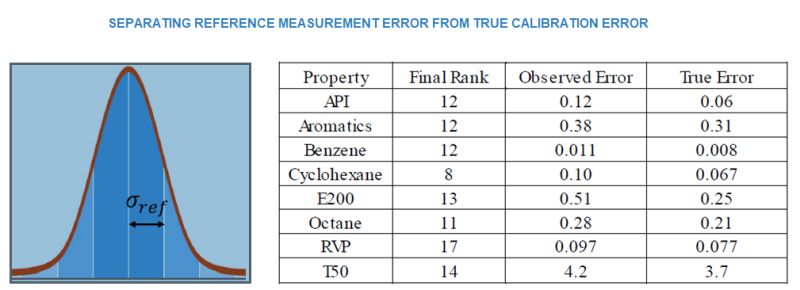
In presenting this information over the last two decades, one commonly hears that “the calibration can only be as good as the reference value”; this statement is not true. Because of the precision of optical spectroscopy, assuming the analyzer physics is appropriate to the task, a well-calibrated spectrometer will outperform most laboratory reference methods. In addition, there are ways of getting a better estimate of the true error of the analysis; the adjustment of the apparent error based on correcting errors in the reference value are the appropriate measure of the quality of the analysis.

Best practices in the laboratory will include assessing the precision of the reference value.  Here, we run a given sample several, even many, times to find the standard deviation of the measurements.  Combining this value with the degrees of freedom (essentially the number of repeat assessments) allows you to estimate the actual error in your spectral analysis.  As can be seen by comparing the observed error for several petroleum laboratory measurements, the true error is typically between 50 and 75% of the error reported in the calibration step.

Here is the link to the full presentation on Minimizing Error in Calibrating Spectrometers from ATC 2025 Conference. Also available in Youtube video from 00:00 to 22:00.

MINIMIZING ERROR IN CALIBRATING SPECTROMETERS Part 3. Continuous Maintenance – Determine the Optimum Number of Factors and Identify Outliers That Degrade Model Performance

In every instance of process or laboratory measurement it pays to understand the source of errors and to minimize those errors where possible. From the sampling system to the instrument or analyzer settings, to the method development used for interpreting the signal, to the maintenance of the calibration over time, all have something to contribute to the error profile. In the case of optical spectroscopy, care needs to be exercised in the initial setup and data processing method development, but once set, these remain constant for the life of the system. Minimizing error then falls to the routine calibration maintenance, which requires constant monitoring of the process results.

In Part 1, one suggestion was to improve the precision of the reference method by running duplicate samples and averaging or adopting the median value. However, we can take advantage of the many samples that are collected during the calibration process, and averaging may not be necessary. Consider a typical calibration as shown in the figure. The distribution of points around the regression line is controlled by errors both in the spectrometer/sampling system and in the reference method. In a gaussian distribution, the best answer is at the apex. If we rotate the regression line to be oriented vertically, we essentially are mapping the points to a gaussian. This means that the best estimate is anywhere on the regression line.

Here is the link to the full presentation on Minimizing Error in Calibrating Spectrometers from ATC 2025 Conference. Also available in Youtube video from 00:00 to 22:00.