Quality Assurance with Ai-Metrix Automated Model Validation

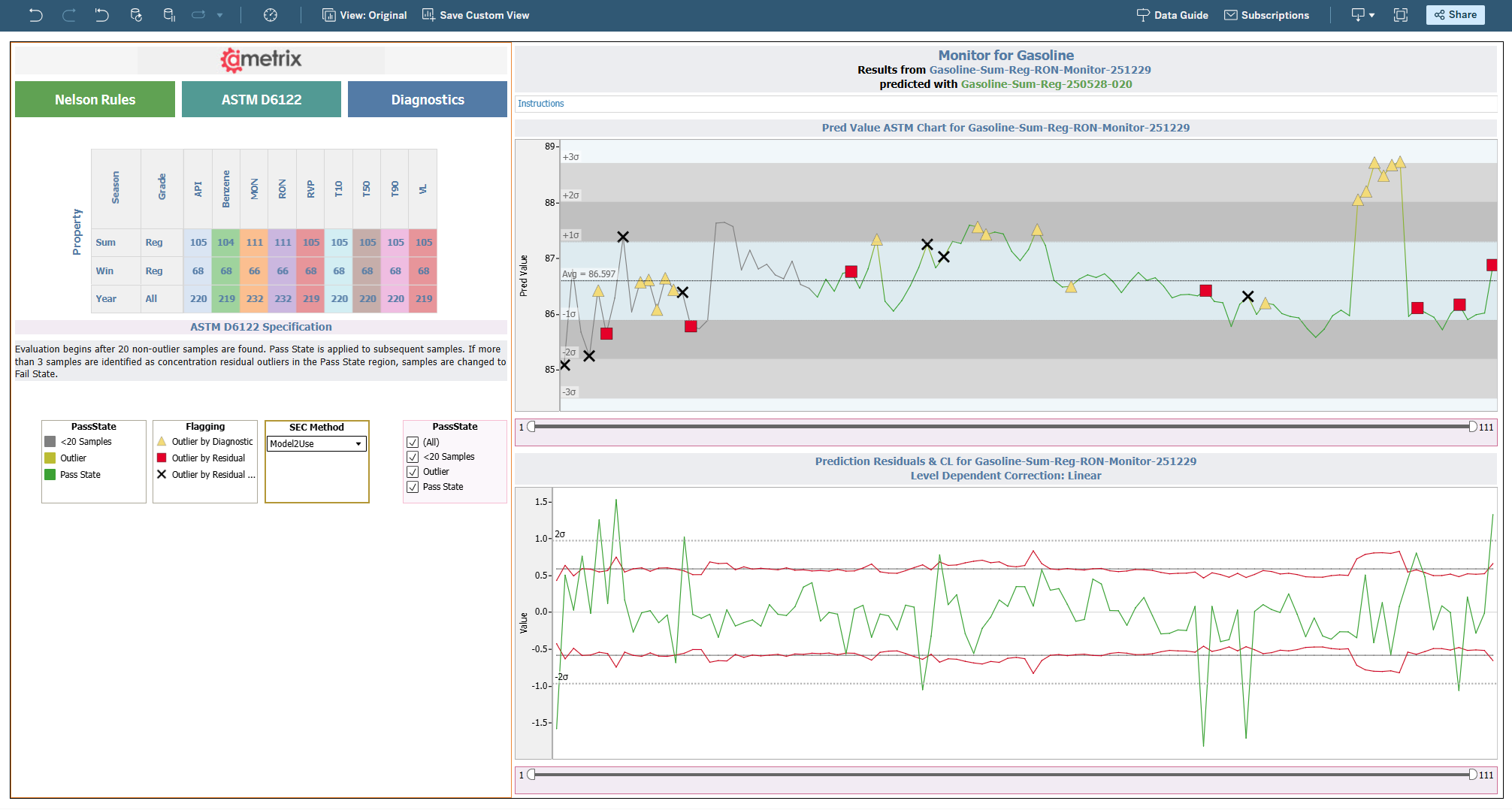
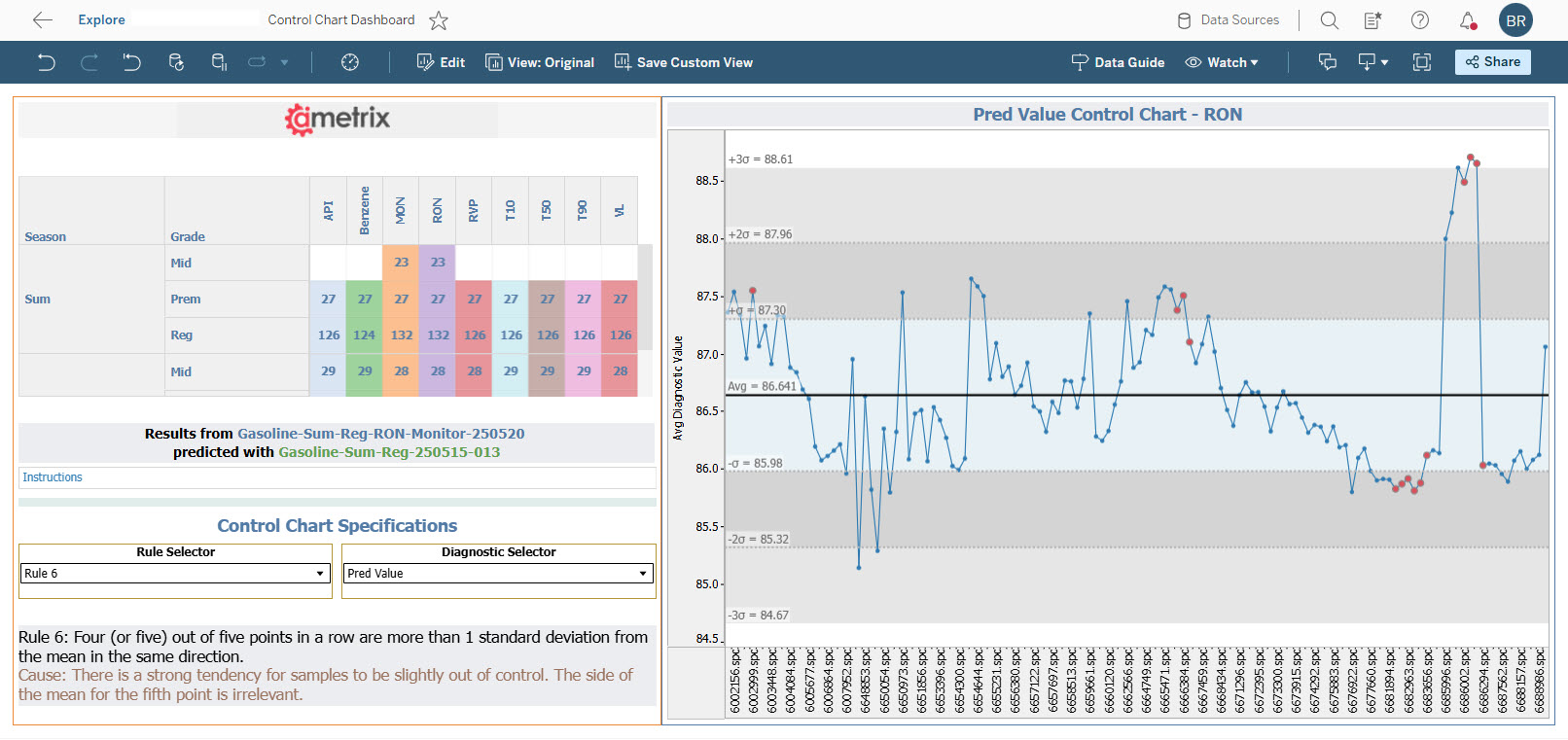
Ai-Metrix Automated Model ValidationAi-Metrix®now offers a fully automated model validation framework, combining real-time tracking with powerful diagnostics based on ASTM D6122 and comprehensive Nelson Rule monitoring. Designed to support high-stakes environments like gasoline blending, this feature ensures your predictive models remain accurate, reliable, and audit-ready as new data flows in.

🎯Smarter Monitoring Starts Here
As your team uploads fresh data to the Ai-Metrix server, our system continuously evaluates model performance using robust statistical tools. A streamlined dashboard gives you instant visibility:

✅ Visual Control Charts – Instantly identify anomalies with trend plots showing ±1, 2, and 3 standard deviations.
✅ Advanced Rule Integration – Choose from Nelson Rules or ASTM D6122 checks to detect early signs of model drift or calibration issues.
✅ Dynamic Model Grid – See all active models at a glance, organized by product grade and property. Click to dive deeper into sample counts and validation metrics.
✅ Flexible Metric Selection – Monitor predicted values, residuals, F-ratios, or Mahalanobis distance to match your validation strategy.
✅ Rule Violations Trigger – Violations can trigger an email to a distribution list for action.

🎯Why It Matters
→ Regulatory Alignment – ASTM D6122 compliance, built-in.
→ Hands-Free Oversight – Continuous, automated validation as data is collected.
→ Proactive Alerts – Catch issues before they affect process quality.
→ Complete Transparency – From calibration sample size to rule violations, everything is traceable and actionable.
→ Real time updates – With the Ai-Metrix calibration power, model updates are available in real time to move the system back into compliance.

🎯Confidence in your models isn’t optional—it’s critical.
Ai-Metrix delivers a smarter, automated approach to model validation that helps your team maintain compliance, ensure process integrity, and make better decisions, faster. Explore the new validation dashboard today and take control of your model quality.

Book a quick demo and see how Ai-Metrix can elevate your operations. info@infometrix.com

“Quality is never an accident. It is always the result of intelligent effort.”
– John Ruskin, English writer (1819-1900)

SciX 2025 Conference – On Machine Learning, PLS, and Local Weighting

Venue: Northern Kentucky Convention Center, Covington, KY

Date: Oct 5 – 10, 2025

Brian Rohrback will be presenting in the session on Artificial Intelligence and Machine Learning in Process Analytical Technology (PAT). See abstract below.

On Machine Learning, PLS, and Local Weighting

AUTHOR: Brian Rohrback
ABSTRACT:
A dozen years ago, Infometrix embraced the target of completely automating the installation and maintenance of any optical spectrometer and for any application. Ultimately, the goal is to identify a generic machine learning approach that can be taken to mimic the results that an experienced chemometrician would achieve if charged with producing an optimized model.  The idea has been presented in numerous publications and this specific work was triggered initially by Workman et al. (1995). Clearly, the chemometrics tasks can be broken down, assigning best practices procedures for each. One part of this process is choosing the algorithmic approach. Partial Least Squares (PLS) is the workhorse and is incorporated into nearly every spectroscopy system.   In cases of non-linearity, a locally weighted application of PLS will avoid the failures of non-linear methods.  Local models can also simplify model maintenance as conditions (spectrometer, ingredients, unit operations) change.

Automation of Local Regression Model Building for Spectroscopic Data – Journal of Chemometrics

ATC 2025 Conference, Visit Booth 420

ATC 2025 Conference, Infometrix Booth 420Venue: Galveston Convention Center, Texas

Date: April 28 – May 2, 2025

Booth: #420

The Analyzer Technology Conference for 2025 is less than a month away.  Join Infometrix in booth 420 for presentation on Ai-Metrix and the automation of chemometric calibrations. Meet with industry peers for informal discussion on new and innovative analyzer techniques, developments, and applications for process and laboratory measurements. Most recently, the fundamentals of quality control employing optical spectroscopy were presented and the paper is available for download.
ATC 2024 Rohrback Paper

Chemometric plus Automation equals Machine Learning and Best Practices.

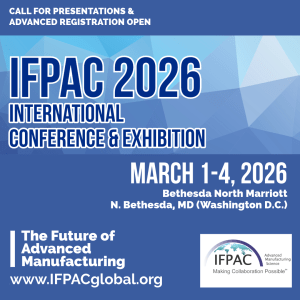
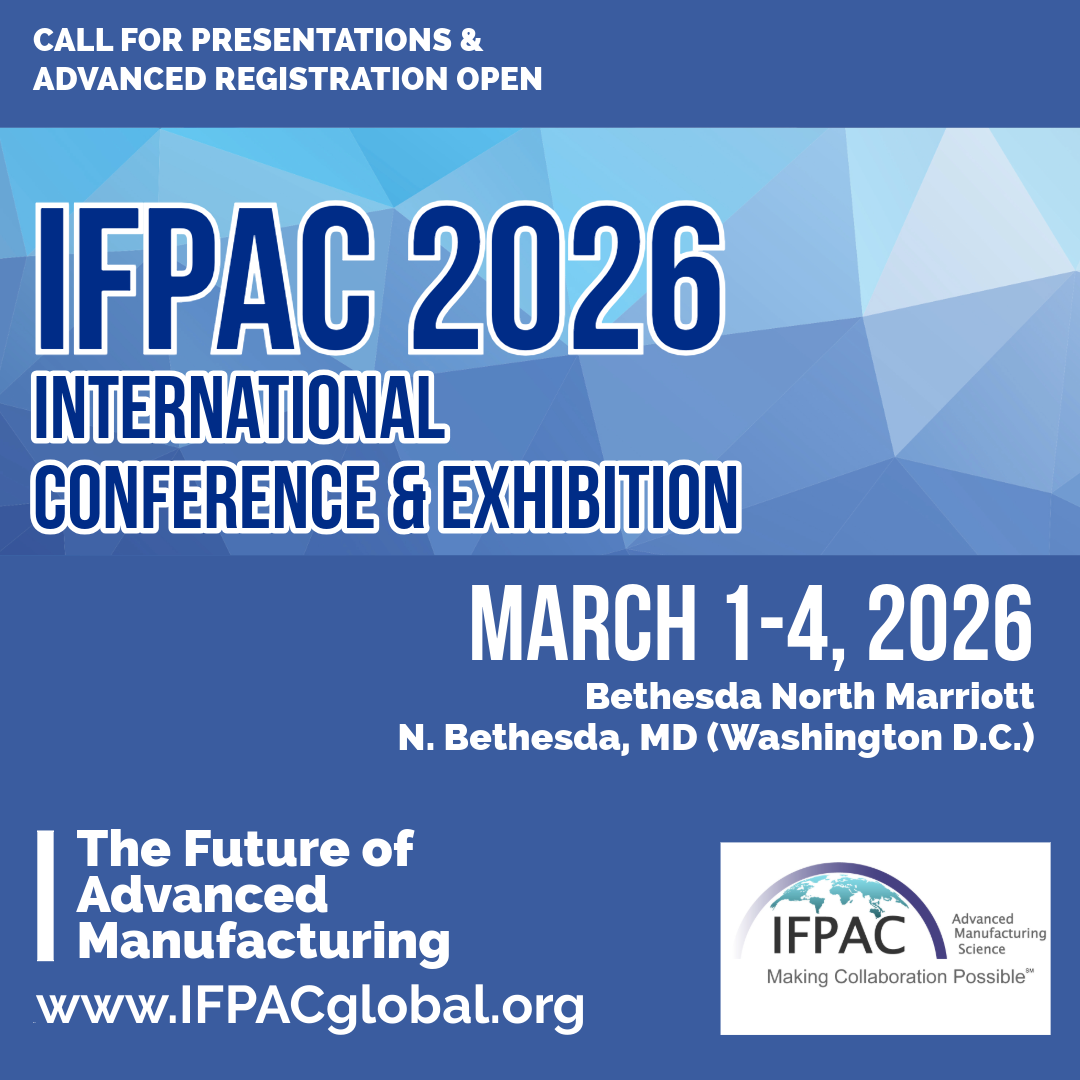
IFPAC 2025 – Infometrix Presentations. Don’t Miss it.

Date: Monday, March 2-5, 2025
Venue:  Bethesda, MD (Washington, D.C.)
website: www.ifpacglobal.org

For more information, contact info@infometrix.com.

Topic:
Sensors/Soft Sensors/Probes/Optics

Advanced Separations: FastGC, HPLC & Data Systems

Author: Brian Rohrback, President

Real Time Data Analysis for Process Development: UPDATE (Abstract #139)

Abstract: We have been musing in the broader business community about broad AI approaches to data analysis, but a narrower focus is much more likely to generate near-term results. Luckily, we have tools that can be placed into the process that simplify the effort of building custom integrated systems.  Here we will discuss current techniques and show how the value of the information stream can be improved by more timely integrated data analysis.  But there is still effort to expend and timeliness is not the only issue. Any desired property metric will likely be only lightly correlated to the bits of data being assembled, so blending the information from disparate sources is necessary.  Looking at the options for data and model fusion shows that improvement is possible, and the answer is mostly free.  What results is a customizable system that can cater to any process or even personalized health evaluation.

Minimizing Error in Calibrating Spectrometers (Abstract #286)

Abstract: The adage “you can’t control what you don’t measure” may be old but it will always hold true. In industrial quality control settings, we choose to deploy optical spectrometers as a mechanism for measuring the chemistry and the physical attributes of the products we produce.  Spectroscopy’s advantage is that it is non-destructive, extremely fast, can be run on-line, and provides quantitative information through the characterization of functional groups in the sample.  Understanding the limits to spectroscopy’s accuracy and precision for a given application is governed by factors we can control and understand plus those that are out of our control.  To minimize error in spectroscopy assessments, there are three primary software-related areas to tackle, two of which the practitioner only needs to do once.

  1. At the start, a method needs to be set that optimizes how future spectra will be manipulated and involves choice of preprocessing and wavelength range plus algorithm selection.
  2. The other early process is to understand the precision of the laboratory methods and how they impact models.
  3. On a continuous basis, a maintenance effort is required to determine the optimum number of factors and identify outliers that degrade model performance.

The History of Chemometrics in Routine Chromatographic Analysis (Abstract #2)

Abstract: There is a rich history of the use of chemometrics both for signal processing and for pattern recognition analysis that dates back a half century now.  The first documented commercial implementations began in the early 1980s, predating the use of “personal” computers.  In considering use for routine quality measurements, the technology divides between signal processing (alignment, curve resolution) and automated interpretation (classification, quantitation, mixture analysis).  The use of standard chemometrics technology vastly reduces the time required to process chromatographic data in a quality control environment and it enables unsupervised chromatographic analysis and interpretation.

Bio:

Brian Rohrback is the President and CEO of Infometrix and has managed the company for several decades.  He has steered Infometrix into position as the dominant independent supplier of chemometrics technology to analytical instrument companies, process analyzer suppliers, and their customers.  His expertise is in the integration of multivariate data processing for process analyzers and laboratory instruments catering to routine quality analysis. Rohrback holds a B.S. and Ph.D. in chemistry specializing in the processing of chromatographic data, plus went to the dark side to get an MBA. His publications span 50 years and cover topics in petroleum exploration, chemical plant optimization, clinical and pharmaceutical diagnostics, informatics, pattern recognition, and multivariate analysis.  In 2016, he was presented the ISA Excellence in Analytical Technical Innovation Award for revolutionary work in the field of chromatography. He has a passion for Classic cars and nearly all aspects of chemistry and process science.

Analytically Speaking Podcast Ep. 33 – Automating Chemometrics for Expert Calibration System

Analytically Speaking Podcast Ep. 33 Host Dr. Jerry Workman speaks with Dr. Brian G. Rohrback to discuss to his research and experience in automating the process of building multivariate calibrations.

Enjoy the podcast. For more information and further conversation, contact us at info@infometrix.com.

Click to access Analytically Speaking Podcast Ep.33